The Refuge
-
Refuge History
The Wichita Mountains Wildlife Refuge (Refuge) is one of more than 500 National Wildlife Refuges managed by the U. S. Fish and Wildlife Service for the purposes of preserving native American wildlife. Originally set aside in 1901 as the Wichita Forest Reserve by President William McKinley, the Refuge was renamed in 1905 by Theodore Roosevelt as the Wichita Game Preserve. On June 4, 1936, Congress officially designated this unique area the Wichita Mountains Wildlife Refuge.
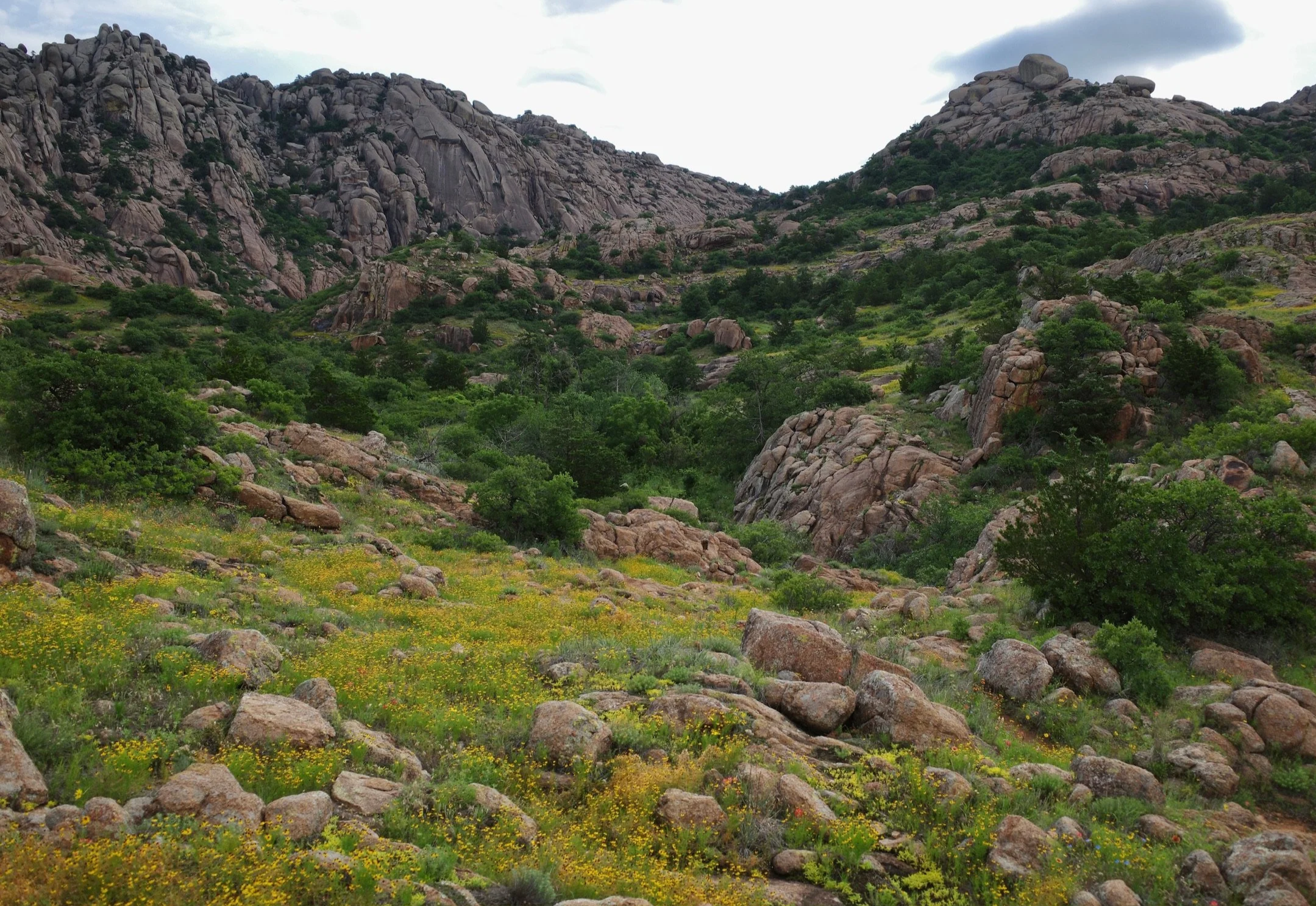
The Refuge is located in southwest Oklahoma and covers an area of more than 59,000 acres. The remarkable landscape is dominated by rugged granite mountains, oak forests, and mixed grass prairies. These unspoiled lands provide excellent habitat and protection for herds of bison and elk, and for numerous other native and migratory species. The preservation of this valuable system of grasslands and prairie herds is the purpose of the Wichita Mountains Wildlife Refuge.
The 22,400 acre public use portion of the Refuge offers visitors the opportunity to broaden their knowledge and appreciation of the natural environment through direct exposure to wildlife and wildlands. Permitted recreational uses such as hiking, camping, rock climbing, fishing, and wildlife observation provide the public an opportunity to gain a renewed appreciation for and commitment to the value of environmental stewardship.
Within the public use area of the Refuge lies the 5,700 acres Charons Garden Wilderness Area, which received special designation by Congress under the Wilderness Act of 1964. This remote, pristine environment offers Refuge visitors a chance to discover the solitude and adventure offered by wilderness lands.
Refuge Climbing
The Wichita Mountains Wildlife Refuge (Refuge) is one of the finest rock climbing areas in the southwest. The Refuge’s high-quality granite, multi-pitch routes, and wilderness setting provide outstanding opportunities for vertical adventures. Thousands of climbing enthusiasts visit the Refuge each year to experience the exceptional climbing found at Mt. Scott, the Narrows, Elk Mountain, Crab Eyes, Lost Dome and other classic sites.
As one of only a few granite climbing areas in this part of the country, the Refuge has an established climbing history dating back more than 50 years. One of the earliest known technical ascents at the Refuge took place in the 1940’s with the first ascent of the route Great Expectations on Elk Slab in the Charons Garden Wilderness Area. Today, hundreds of quality routes in the 5.6 to 5.11 difficulty range have been established at the Refuge. A majority of these were done in traditional, ground-up style. And, while there have been a number of “sport” type routes developed at several areas around the early 2000s, the Refuge remains predominantly a traditional climbing area.
Prior to 1996, technical rock climbing had historically been an unregulated activity at the Refuge. Aside from general public use regulations, climbers were allowed to carry out their activities with no restrictions. However, as the popularity of rock climbing began to increase across the country in the late 1980’s, so did the number of climbers visiting the Refuge. Along with this increased usage came noticeable impacts to some areas of the Refuge. Soil erosion, trail degradation, litter, and proliferation of fixed anchors became serious concerns for the U.S. Fish and Wildlife Service. As a result, new management policies and regulations for technical rock climbing went into effect in May of 1996 to insure that climbing resources and the natural environment of the Refuge were protected.
Today, thanks to the efforts of the U. S. Fish and Wildlife Service and the Wichita Mountains Climbers Coalition, rock climbing remains a valuable and compatible recreational use of the Refuge, providing thousands of visitors each year with the opportunity to experience outstanding climbing adventures in a unique wilderness setting.
For more information about rock climbing at the Refuge, contact the WMCC.
For detailed climbing history, technical information, and route descriptions, purchase a copy of “The Oklahoma Climber’s Guide” by Chuck Lohn, “Oklahoma Select, A Climbers Guide” by Tony Mayse, and “Refuge Bouldering” by Ryan Sheldon.
-
REFUGE HEADQUARTERS:
Location: 6 miles west of the Visitor Center, just south of Highway 49
Hours: 8:00 am to 4:30 pm, Monday through Friday
Available: general information, backcountry permits, and fixed anchor applications
Telephone: 580-429-3222VISITOR CENTER:
Location: intersection of Highway 115 and Highway 49
Hours: 10:00 am to 5:30 pm, Closed Tuesdays
Available: general information, exhibits, book and map sales
Admission: freePARKING:
Parking is designated at all picnic areas and trailheads. Do not block gates or other vehicles. Parking space is limited. Help ease traffic congestion by carpooling. To reduce the risk of theft, always conceal valuables and equipment.
Do NOT park on any grass or a spot that is not a designated parking area. If a lot is full, go to a different area.
CAMP DORIS:
Location: 2 miles west of the Visitor Center on the south side of Highway 49
Hours: seasonal, call Refuge Headquarters for times.
Available: 70 individual campsites, 20 primitive walk-in campsites, 3 group campsites, picnic tables, grills, firepits, bathrooms, showers, drinking water, telephoneCampsite reservations must be made online at: recreation.gov/camping/campgrounds/10038733
Note: After hours registration for campsites is not allowed. If you are not able to obtain a campsite prior to gate closing, do not walk-in and occupy a site. A significant fine may result.
Additional camping is available at the Lake Lawtonka campground, just east of the Refuge, or at the Lake Elmer Thomas Recreation Area, located on the south shore of the lake at Ft. Sill.
LAKE LAWTONKA CAMPGROUND:
Location: on the east side of Lake Lawtonka, just east of the Refuge. On the west side of Highway 58 approximately 2 miles north of Highway 49
Hours: campsites may be obtained 24 hours a day
Available: bathrooms, showers, picnic tables, grillsLAKE ELMER THOMAS RECREATION AREA (LETRA)
Location: on the south shore of Lake Elmer Thomas at Ft. Sill Military Base. Before 10pm, enter Ft. Sill by turning south off of Highway 49 at Apache Gate (just east of I-44 and across from Love’s Country Store); turn right on North Boundary Road and follow it west to LETRA. After 10pm, enter Ft. Sill by exiting west off of I-44 at Key Gate north of Lawton; turn right (west) on Sheridan Road; turn right (north) at Currie Road (Burger King); turn left (west) on Randoph Road; turn right (north) on Tower 2 Road; follow signs to LETRA.
Hours: campsites may be obtained 24 hours a day
Available: group sites, restrooms, showers, picnic tables, grills, convenience store, laundry, lodge, restaurant, swimming beach, mountain bike and canoe rentals
Fees: $3.00 per night per tent
Information and reservations: LETRA – 580-442-5541Store – 580-442-5858 -
Refuge Regulations
GENERAL
No fees are required for visiting the Refuge.
The Public Use areas of the Refuge are open to visitors during daylight hours.
General camping is permitted only at Camp Doris. A fee is required.
Backcountry camping requires a permit and is allowed only in certain designated areas.
Swimming is not allowed in any Refuge waters.
Off-road bicycles are restricted to the Mt. Scott trail.
Alcoholic beverages, including 3.2 beer, are prohibited on the Refuge.
All pets must be kept on a leash at all times while on the Refuge
CLIMBING
Technical rock climbing is allowed throughout the Public Use portion of the Refuge during daylight hours, with the following exceptions:
Sport rappelling is prohibited in the area popularly known as the “Narrows”, which is defined as the area along West Cache Creek downstream of Boulder Cabin.
Placement, removal, or replacement of fixed anchors, including bolts, pitons, rivets, coldshuts, and chains, is prohibited without prior approval of Refuge Management through the Advisory Bolting Committee (ABC) of the Wichita Mountains Climbers Coalition. Any climber desiring to add, remove, or replace any fixed anchor must submit a “Fixed Anchor Application” for review by Refuge Management and the ABC. Applications are reviewed quarterly, and the reviews are based on aesthetic and natural resource criteria. Applications are available at Refuge Headquarters.
Commercial or instructional operators who charge for their services while on Refuge lands are required to obtain an annual Special Use Permit from the Refuge Manager. Fee required.
FOR MORE INFORMATION ABOUT SPECIFIC REFUGE REGULATIONS, OR TO OBTAIN REQUIRED PERMITS, PLEASE VISIT REFUGE HEADQUARTERS OR CALL 580-429-3222.
Wildlife, Weather and Climbing Cautions
In order to ensure that your visit to the Wichita Mountains Wildlife Refuge is both safe and enjoyable, there are a number of important things to remember.
Buffalo, longhorn and other big game animals freely roam the Public Use area, and should be considered extremely dangerous. Visitors are advised to keep safe distances from these animals at all times.
Rattlesnakes are abundant and active on the Refuge, and they are very poisonous. Visitors are advised to pay close attention when traveling on foot, especially in the backcountry areas of the Refuge.
Thunderstorms containing heavy rains, strong winds, and lightning can develop quickly and without warning. Visitors are advised to be aware of changing weather conditions during any trip to the Refuge. Always carry foul-weather gear, and be prepared to seek shelter.
Seasonal temperatures at the Refuge can vary from well-below freezing in the winter to more than 100 degrees in the summer. Visitors are advised to wear the necessary protective clothing, as dictated by the weather, and to always carry an adequate supply of drinking water.
Solo traveling in the backcountry areas of the Refuge, even for the experienced adventurer, has numerous risks and dangers. Visitors are advised to leave notice with a friend, at your vehicle, or at Refuge Headquarters of your intended destination and length of stay before venturing out on your own.
U.S. Fish and Wildlife Service
Wichita Mountains Wildlife Refuge
Route 1, Box 448
Indiahoma, OK 73552
580-429-3222
wichitamountains@fws.gov
fws.gov/refuge/Wichita_Mountains
Statement of Non-Liability for Climbing and Fixed Anchors
The U.S. Fish and Wildlife Service (USFWS), Wichita Mountains Climbers Coalition (WMCC), and the WMCC’s Advisory Bolting Committee (ABC) review fixed anchor applications and make recommendations concerning fixed anchors based upon aesthetic and natural resource criteria. The USFWS, WMCC, and ABC make no representations or warranties regarding the safety, reliability or suitability for use of any fixed anchors or other hardware, currently existing or installed in the future, on any climbing route in the Wichita Mountains Wildlife Refuge (Refuge). Moreover, the USFWS, WMCC, and ABC make no representations or warranties regarding the degree of hazard or danger involved, or lack thereof, on any rock climbing route in the Refuge. Rock climbing is a dangerous activity and the individual climber must personally make all decisions regarding his or her own safety while climbing.